Guide
Barrier Films Explained
A pouch's barrier is its resistance to oxygen, moisture, light and aroma loss, and it is set by the laminate structure rather than by how thick the pouch feels. The two numbers that matter are OTR (oxygen transmission rate) and MVTR (moisture vapour transmission rate) — lower is better on both. Foil and metallised structures give the highest barrier, clear laminates the lowest, and mono-material recyclable films sit in between.
What do OTR and MVTR actually mean?
OTR is how much oxygen passes through a square metre of the film in 24 hours. It is the number that governs whether fats go rancid, whether vitamins degrade and whether roasted coffee tastes flat after eight weeks.
MVTR is the same idea for water vapour. It governs whether crisps go soft, whether powder cakes into a block and whether a hygroscopic supplement clumps.
Both are measured under stated temperature and humidity conditions, so two figures are only comparable if the test conditions match. When you ask a supplier for barrier data, ask for the conditions with the number.
| Structure | Oxygen barrier | Moisture barrier | Light barrier | Typical use |
|---|---|---|---|---|
| Clear PET/PE laminate | Low | Moderate | None | Confectionery, short-shelf-life dry goods, product-visible packs |
| Metallised PET laminate | High | High | Full | Snacks, granola, protein powder |
| Aluminium foil laminate | Highest | Highest | Full | Coffee, supplements, freeze-dried food, anything oxygen-critical |
| Kraft paper with foil liner | High | High | Full | Coffee and tea with a natural shelf look |
| Mono-material PE (recyclable) | Moderate | Moderate to high | Depends on print | Dry goods where recyclability outranks maximum shelf life |
Which barrier does my product need?
Work from the failure mode rather than the product name. Ask what spoils first: does it oxidise, absorb moisture, lose aroma, or fade in light? Roasted coffee fails on oxygen and aroma, so it needs a foil-grade structure plus a degassing valve. Crisps fail on moisture and light. A hard sweet fails on almost nothing, so a clear laminate is fine and lets the product sell itself.
Then set the shelf life you need on paper. Twelve months of protection is a different specification from three months, and over-specifying barrier costs money in every unit you ever buy.
If you are unsure, tell us the product, the target shelf life and where it will be stored when you send your spec, and we will specify the structure rather than asking you to guess.
Does a thicker pouch mean a better barrier?
No, and this is the most common misconception in flexible packaging. Barrier comes from the layers in the laminate — specifically from the aluminium, metallised or EVOH layer — not from total thickness. A thicker all-polyethylene pouch feels more substantial and still has a mediocre oxygen barrier. A thinner foil laminate outperforms it by orders of magnitude.
Thickness does matter for puncture resistance, seal strength and how the pack stands, which is why heavier gauges are used for pet food and sharp-edged products. Choose gauge for physical durability and structure for barrier — they are two separate decisions.
The recyclability trade-off, stated honestly
Mono-material structures are recyclable because every layer is the same polymer family — but that is also why they cannot include an aluminium layer, which is what caps their barrier. Coatings and EVOH layers close some of the gap and mono-material PE now handles most dry goods well.
For oxygen-critical products the trade-off is real today. The right approach is to quote both and compare shelf life properly, rather than picking a structure on principle and discovering the problem after launch. PPWR makes this decision more pressing for anyone selling into the EU.
Not sure which pouch size you need? Tell us what you are packing and we will check the specification.
Get My Pouch Quote →Related questions

Quick answers
What is a high barrier pouch?
A pouch whose laminate includes an aluminium foil or metallised layer, giving very low oxygen and moisture transmission plus a complete light block. It is the standard specification for coffee, supplements and freeze-dried food.
What is a good OTR for food packaging?
It depends entirely on the product and target shelf life — a foil laminate can be several orders of magnitude lower than a clear laminate. Rather than chasing a number, tell us the product and the shelf life you need and we will specify a structure that reaches it.
Does a clear window reduce the barrier?
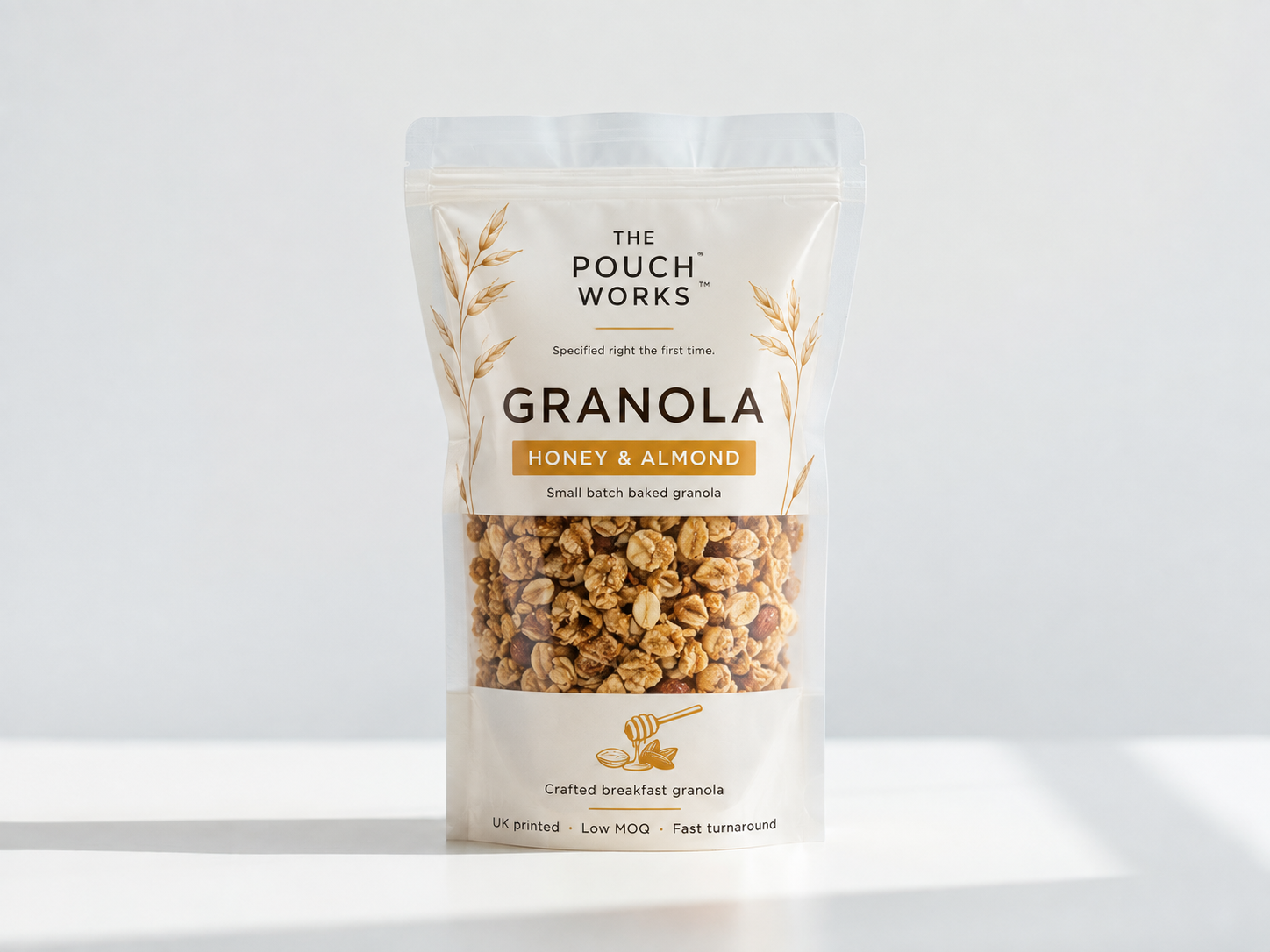
Yes. A window replaces the foil or metallised layer over that area, so oxygen, moisture and light get through there. A small window on a short-shelf-life product is usually fine; a full clear face on roasted coffee is not.
Do I need a valve on a coffee bag?
If you pack freshly roasted coffee, yes. Roasted beans release CO2 for days and a sealed high-barrier bag without a one-way valve will swell and can burst its seals.
Can you tell me the exact OTR of the film you quote?
Yes. Ask in your enquiry and we will supply the technical data sheet for the specific structure, including the test conditions the figures were measured under.
Still have questions? Email hello@thepouchworks.com and we'll get back to you within one business day.